
Software Development & Digital Solutions Services
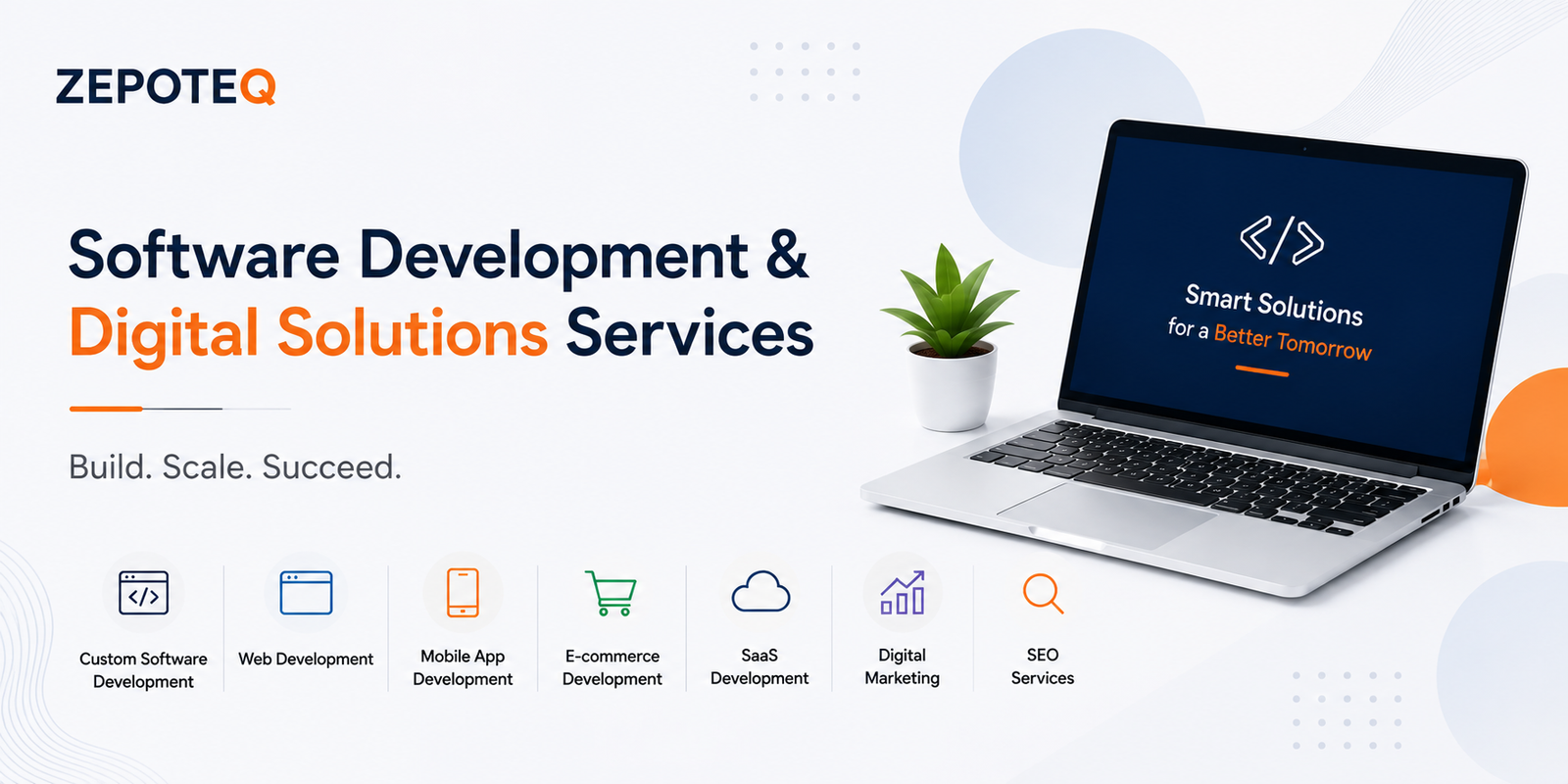
Technology has become an important part of almost every modern business. A company may need a professional website to attract customers, a custom software platform to manage operations, an e-commerce system to sell products, a mobile application to improve customer engagement, or a SaaS product to launch a new digital business model. As the business grows, it may also need SEO, digital marketing, analytics, automation, integrations, and continuous product improvements.
However, building each part independently can create unnecessary complexity. Different vendors may use different technologies, follow different processes, or have different priorities. This can make communication harder and can also create integration and maintenance challenges.
ZepoteQ provides a broad range of software development and digital solutions designed to help businesses plan, build, launch, and improve digital products. Its service areas include custom software development, SaaS development, website and web application development, e-commerce development, mobile app development, UI/UX design, SEO, digital marketing, and technology-driven automation and transformation.
The important point is that these services do not have to operate separately. A business can combine development, design, marketing, and growth services into one connected roadmap. This article explains what these services mean, when businesses need them, how they can work together, and how to choose the right technology approach.
What Are Software Development Services?
Software development services cover the process of planning, designing, building, testing, deploying, and maintaining software applications. Depending on the business requirement, software can be built for customers, employees, administrators, partners, or internal operations.
Custom software development is particularly useful when standard software cannot fully support a company’s workflow. A custom system can be designed around specific business rules, user roles, integrations, reporting requirements, and future growth plans.
A professional development process normally begins with requirement discovery and business analysis. The team then defines the product scope, user journeys, architecture, technology stack, database structure, integrations, testing approach, deployment process, and support requirements. This planning helps reduce unnecessary development and creates a stronger foundation for future improvements.
1. Custom Software Development Services
Every business has its own processes. A distributor may need inventory and order workflows, a service company may need a booking and customer management platform, and a growing enterprise may need dashboards that connect multiple internal systems. Generic software can help with common tasks, but it may not match specialized workflows.
Custom software development allows a company to build technology around its actual business requirements. The system can include role-based access, dashboards, workflow automation, APIs, databases, notifications, reports, third-party integrations, and other features required by the organization.
ZepoteQ can be positioned as a technology partner for businesses that need custom digital systems rather than only ready-made software. The development process should focus on solving the business problem first and selecting technology second.
Typical custom software work can include requirement analysis, system architecture, frontend development, backend development, database design, API development, third-party integrations, testing, deployment, maintenance, and scalability improvements.
2. SaaS Development Services
Software as a Service, commonly known as SaaS, allows users to access software through the internet. SaaS products can serve businesses, consumers, or specific industries and are often designed around recurring subscriptions or account-based access.
Developing a SaaS product requires more than building a standard website. The product may need user registration, authentication, role management, subscription plans, billing integration, dashboards, notifications, data isolation, analytics, administration tools, security controls, and scalable infrastructure.
For startups, SaaS development often begins with an MVP that focuses on the most important customer problem. After real users provide feedback, the product can evolve through additional features, integrations, automation, and performance improvements.
ZepoteQ can support the broader SaaS development lifecycle, from idea and MVP planning to UI/UX, application development, deployment, and ongoing product improvements. The exact technology stack should be selected according to the product’s users, scale, integrations, and long-term requirements.
3. Website & Web Application Development
A website is often the first digital interaction between a business and a potential customer. A professional website should communicate the business value clearly, work well on mobile devices, load efficiently, and provide a simple path toward actions such as contacting the company, requesting a quote, booking a service, or making a purchase.
Web application development goes beyond informational pages. It can include dashboards, customer portals, booking systems, marketplaces, management systems, online tools, and other browser-based applications.
For businesses that depend on their website for leads or sales, development should also consider SEO structure, analytics, conversion paths, performance, accessibility, security, and content management. A website should not only look good; it should support measurable business objectives.
4. E-commerce Development Services
E-commerce development connects products, customers, payments, orders, inventory, marketing, and customer support in one digital buying journey. For an online business, the website or store becomes a critical part of revenue generation and customer experience.
A strong e-commerce solution should make product discovery simple, provide clear product information, support secure checkout, work well on mobile devices, and make post-purchase processes easier to manage. It should also be designed for future growth.
ZepoteQ’s e-commerce development approach can include storefront development, custom shopping experiences, payment integrations, product and order workflows, third-party integrations, performance improvements, responsive design, SEO considerations, and conversion-focused optimization.
For businesses with existing stores, development may also involve improving specific parts of the customer journey instead of rebuilding everything. The right approach depends on the current platform, business goals, technical limitations, and expected scale.
5. Mobile App Development Services
Mobile applications can create a more direct and convenient experience for customers, employees, or business partners. A company may need an app for shopping, booking, communication, loyalty, internal operations, field work, education, finance, or another specialized use case.
Mobile development can involve Android, iOS, or cross-platform approaches. The right choice depends on the target audience, feature requirements, device capabilities, budget, maintenance expectations, and long-term product roadmap.
A successful mobile application requires more than coding. User flows, interface design, performance, authentication, APIs, notifications, security, testing, analytics, and app-store requirements all need to be considered.
ZepoteQ can combine mobile app development with backend systems, APIs, UI/UX design, databases, and other services so that the application works as part of a broader digital ecosystem.
6. UI/UX Design Services
Good technology can still create a poor customer experience if users cannot understand how to navigate it. UI/UX design focuses on making digital products clear, usable, consistent, and aligned with user expectations.
UX work can include user research, customer journeys, information architecture, wireframes, user flows, prototypes, and usability improvements. UI design then turns those structures into a visual interface through layouts, typography, components, icons, spacing, and responsive behavior.
For software products, good UI/UX can reduce confusion, improve onboarding, make important actions easier to find, and help users complete tasks more efficiently. For websites and e-commerce stores, it can also support better engagement and conversion.
ZepoteQ can integrate UI/UX design with development so that designs are created with real technical requirements, responsive behavior, and implementation in mind.
7. SEO Services & Search Optimization
Creating a website does not automatically make a business visible in Google. Search engine optimization helps businesses improve their organic visibility for relevant searches.
SEO can include technical optimization, keyword research, content strategy, on-page optimization, internal linking, metadata, structured content, performance improvements, indexing checks, and ongoing Search Console analysis.
A strong SEO strategy should focus on search intent rather than simply inserting keywords into pages. For example, someone searching for software development services may be looking for a service provider, while someone searching for what software development means may be looking for educational information. The page should match the user’s purpose.
SEO should also be measured through meaningful metrics such as impressions, clicks, CTR, rankings, organic users, conversions, and qualified leads. This allows a business to improve its content based on actual search behavior instead of assumptions.
8. Digital Marketing Services
Organic search is only one part of digital growth. Businesses may also need social media campaigns, paid advertising, content distribution, lead-generation campaigns, remarketing, and conversion optimization.
Digital marketing becomes more effective when the website and product experience are ready to convert visitors. A campaign can generate traffic, but the landing page must explain the offer clearly and provide a simple next step.
ZepoteQ can connect digital marketing with website development, landing pages, analytics, SEO, and conversion-focused improvements. This creates a more connected approach in which marketing results can inform product and website optimization.
9. AI, Automation & Digital Transformation
AI and automation can help businesses reduce repetitive work, process information faster, and create more efficient workflows. However, technology should be selected because it solves a real business problem, not simply because it is popular.
Potential applications include automated workflows, intelligent customer support, data analysis, predictive systems, AI-assisted content or operations, document processing, recommendations, and integrations between business systems.
A useful digital transformation project normally starts by identifying where time, cost, errors, or customer friction are highest. The technology solution can then be designed around those problems.
ZepoteQ can support businesses that want to introduce automation or AI into existing systems or build new technology-driven products. The implementation should consider data quality, security, user permissions, integration requirements, performance, and long-term maintenance.
10. API & Third-Party Integration
Modern businesses rarely operate with one system. They may use payment gateways, CRM tools, marketing platforms, accounting software, shipping systems, messaging platforms, analytics tools, marketplaces, and other external services.
API integration allows these systems to exchange information and automate workflows. For example, an order can trigger an internal process, a payment can update an account, or customer information can be synchronized between applications.
How ZepoteQ Services Can Work Together
The biggest advantage of a broad technology partner is the ability to connect services around one business goal. Instead of buying isolated services, a company can build a phased roadmap.
Step 1 — Discover: understand the business model, customers, current technology, operational problems, goals, and measurable outcomes.
Step 2 — Plan: define scope, priorities, architecture, technology choices, user roles, integrations, timeline, and success metrics.
Step 3 — Design: create user journeys, wireframes, prototypes, visual design, and responsive layouts.
Step 4 — Develop: build the website, custom software, SaaS platform, e-commerce system, mobile app, APIs, or integrations.
Step 5 — Test: check functionality, usability, performance, security, responsiveness, and compatibility.
Step 6 — Launch: deploy the product, configure analytics, tracking, SEO, monitoring, and operational workflows.
Step 7 — Grow: use SEO, digital marketing, analytics, automation, and continuous product development to improve results.
This connected approach is useful because a website can support SEO, the software can provide business automation, the mobile app can improve engagement, and analytics can show where customers or users need a better experience.
Which Digital Service Does Your Business Need?
Businesses do not always need every service at the same time. The correct combination depends on the problem and growth stage.
New online presence → Website Development: build a professional, responsive website designed around visibility and lead generation.
Unique internal workflow → Custom Software Development: build a system around specific business operations.
New subscription product → SaaS Development: create a scalable online software product.
Online selling → E-commerce Development: build or improve the digital buying journey.
Customer or employee mobile experience → Mobile App Development: provide direct mobile access to services or workflows.
Low usability → UI/UX Design: simplify journeys and improve the product experience.
Low organic visibility → SEO Services: improve relevant search visibility and organic traffic.
Need more online acquisition → Digital Marketing: reach and convert potential customers through digital campaigns.
Manual repetitive processes → AI and Automation: reduce repetitive work and improve operational efficiency.
Multiple disconnected systems → API and Integration: connect data and workflows across platforms.
How to Choose the Right Technology Partner
Start with the business problem. A good technology partner should ask what the business wants to achieve before recommending a technology.
Look for experience across the full project lifecycle, including discovery, design, development, testing, deployment, support, and future improvements.
Consider communication and project visibility. Regular updates, documentation, milestones, and clear responsibilities can reduce project uncertainty.
Evaluate post-launch support. Digital products need updates, monitoring, bug fixes, security improvements, and feature development after launch.
Why Businesses Can Work with ZepoteQ
ZepoteQ presents itself as a business software solutions and technology company with capabilities across software, SaaS, web, mobile, design, SEO, marketing, and digital transformation. This broader service model can be useful for businesses that need several digital capabilities during the same growth journey.
Rather than treating every requirement as an isolated project, a business can plan technology as a long-term roadmap. For example, a company may begin with a website, add a customer portal, integrate its business systems, launch a mobile application, improve SEO, and then introduce automation as operations scale.
Conclusion
Software development and digital transformation are not simply about creating technology. They are about using technology to solve business problems, improve customer experiences, automate operations, and create sustainable growth.
ZepoteQ’s range of services covers the major areas businesses may need during this journey: custom software development, SaaS development, websites and web applications, e-commerce development, mobile applications, UI/UX design, SEO, digital marketing, AI and automation, and API integrations.
By connecting these services into one roadmap, businesses can move more efficiently from idea to product, from product to launch, and from launch to measurable growth. The right approach is not to implement every service at once, but to prioritize the capabilities that directly support the business objective.
If your business is planning a new digital product, improving an existing platform, automating operations, or strengthening its online presence, the first step is to define the problem and desired outcome. From there, ZepoteQ can help identify the right combination of technology, development, design, and digital growth services.
FAQ's
1. What software development services does ZepoteQ provide?
ZepoteQ provides custom software, SaaS, web, e-commerce, mobile app, and digital solutions.
2. Why choose custom software development?
It helps businesses build software specifically around their workflows, requirements, and growth needs.
3. Does ZepoteQ provide SEO and digital marketing?
Yes, ZepoteQ provides SEO, digital marketing, UI/UX, and development services under one digital solutions approach.
4. Can ZepoteQ develop SaaS, e-commerce, and mobile apps?
Yes, ZepoteQ develops SaaS platforms, e-commerce solutions, websites, web applications, and mobile apps.
5. How can I start a project with ZepoteQ?
Share your business requirements and goals with ZepoteQ to identify the right technology and development solution.