
Build-Operate-Transfer vs Managed Teams: Which Model Works Best for Your Business in 2026?
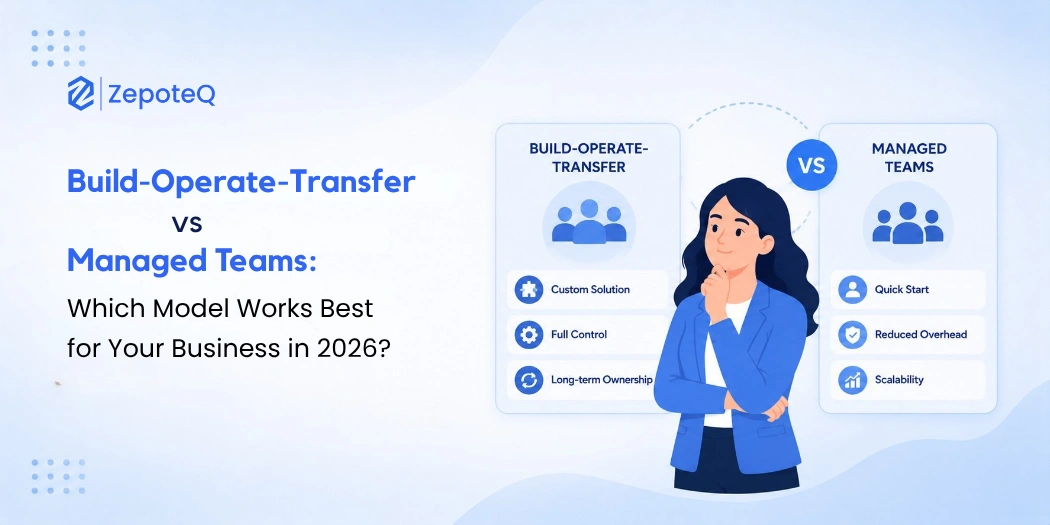
As businesses continue to accelerate their digital transformation initiatives in 2026, access to skilled technology talent has become one of the biggest competitive advantages. Companies worldwide are expanding software development capabilities, adopting Artificial Intelligence, building SaaS products, modernizing infrastructure, and launching digital solutions faster than ever before.
However, hiring and managing highly skilled technology professionals remains a challenge. Rising recruitment costs, talent shortages, operational complexity, and the need for rapid scalability have led businesses to explore alternative workforce models.
Two of the most popular approaches are the Build-Operate-Transfer (BOT) Model and the Managed Teams Model.
Both models help organizations access global talent while reducing operational burden, but they serve different business goals and long-term strategies.
For companies evaluating offshore development, dedicated technology teams, or global delivery centers, understanding the differences between BOT and Managed Teams is critical.
In this comprehensive guide, we’ll compare both models in detail and help you determine which approach is best suited for your business in 2026.
Understanding the Build-Operate-Transfer (BOT) Model
The Build-Operate-Transfer model is a structured outsourcing approach where a technology partner establishes and operates a dedicated offshore team on behalf of a client before eventually transferring ownership and control.
The process typically involves three stages:
Build Phase
The outsourcing partner:
- Recruits talent
- Establishes infrastructure
- Sets up operations
- Implements processes
The goal is to build a fully functional offshore development center.
Operate Phase
The partner manages:
- Team operations
- HR processes
- Compliance
- Infrastructure
- Administrative activities
During this phase, the client focuses primarily on product development and strategic direction.
Transfer Phase
Once the operation becomes stable, ownership transfers to the client.
The client gains:
- Full team ownership
- Direct management control
- Operational independence
The offshore center effectively becomes an extension of the client’s organization.
Understanding the Managed Teams Model
The Managed Teams Model provides businesses with a fully managed technology team that remains under the operational control of the service provider.
In this model:
- The provider recruits talent.
- The provider manages employees.
- The provider handles infrastructure.
- The provider oversees delivery operations.
The client focuses on:
- Business objectives
- Product requirements
- Strategic priorities
Unlike BOT, ownership of the team does not transfer.
Why Businesses Are Exploring Alternative Team Models in 2026
Several factors are driving demand for BOT and Managed Teams.
Global Talent Shortages
Finding experienced software engineers remains challenging.
Faster Time-to-Market
Businesses need rapid team deployment.
Cost Optimization
Organizations seek efficient scaling without excessive overhead.
Digital Transformation
Technology initiatives require specialized expertise.
AI and Emerging Technologies
Demand for advanced technical skills continues to increase.
These challenges make alternative workforce models highly attractive.
Key Differences Between BOT and Managed Teams
Ownership Structure
Build-Operate-Transfer
The client eventually owns:
- Team
- Operations
- Infrastructure
BOT is ideal for companies seeking long-term ownership.
Managed Teams
The service provider retains ownership and operational responsibility.
Clients benefit from flexibility without ownership obligations.
Winner
Depends on business objectives.
Speed of Deployment
BOT Model
Building an offshore center requires:
- Recruitment
- Infrastructure setup
- Process implementation
Deployment may take longer.
Managed Teams Model
Providers often have established systems and talent networks.
Teams can be deployed rapidly.
Winner
Managed Teams
Operational Responsibility
BOT Model
After transfer, the client assumes responsibility for:
- HR management
- Compliance
- Infrastructure
- Administration
Managed Teams Model
The provider handles all operational activities.
Winner
Managed Teams
Long-Term Control
BOT Model
Provides complete operational control after transfer.
Organizations can build proprietary capabilities.
Managed Teams Model
Control remains partially shared with the provider.
Winner
BOT
Scalability
BOT Model
Scaling requires additional recruitment and operational planning.
Managed Teams Model
Providers typically scale teams quickly based on demand.
Winner
Managed Teams
Advantages of the Build-Operate-Transfer Model
Long-Term Ownership
Businesses gain full ownership of offshore operations.
Strong Organizational Integration
Transferred teams become part of the company culture.
Greater Strategic Control
Organizations manage processes directly.
Intellectual Property Security
Direct ownership may simplify IP management.
Sustainable Global Expansion
BOT supports long-term international growth strategies.
Advantages of the Managed Teams Model
Faster Team Setup
Teams can often be operational within weeks.
Reduced Administrative Burden
Providers manage operational responsibilities.
Lower Risk
Businesses avoid establishing legal entities and infrastructure.
Flexibility
Teams can expand or contract based on project requirements.
Access to Specialized Expertise
Providers maintain extensive talent networks.
When Should Businesses Choose BOT?
The BOT model is ideal for organizations that:
Plan Long-Term Expansion
Building a permanent offshore center supports strategic growth.
Want Full Ownership
Organizations seeking operational independence benefit from BOT.
Require Deep Integration
Long-term teams often integrate more closely with internal processes.
Have Strong Management Capabilities
Companies prepared to manage operations after transfer are strong BOT candidates.
When Should Businesses Choose Managed Teams?
Managed Teams are ideal for businesses that:
Need Rapid Scaling
Projects requiring immediate talent benefit from faster deployment.
Want Operational Simplicity
Providers handle administrative responsibilities.
Prioritize Flexibility
Managed Teams adapt quickly to changing requirements.
Focus on Core Business Functions
Organizations avoid operational distractions.
Cost Comparison: BOT vs Managed Teams
Build-Operate-Transfer Costs
Includes:
- Recruitment
- Infrastructure
- Office setup
- Transition activities
Higher initial investment but long-term ownership value.
Managed Teams Costs
Typically involve:
- Monthly service fees
- Team management costs
- Operational support
Lower upfront investment and predictable budgeting.
How AI and Automation Are Influencing Both Models
In 2026, AI continues to reshape workforce strategies.
Both BOT and Managed Teams increasingly leverage:
AI-Powered Recruitment
Faster talent acquisition.
Automated Operations
Improved efficiency.
Performance Analytics
Enhanced team visibility.
Collaboration Tools
Better communication across distributed teams.
Technology is improving outcomes regardless of the chosen model.
Challenges of the BOT Model
Potential challenges include:
Longer Setup Time
Building operations takes time.
Transfer Complexity
Ownership transitions require careful planning.
Increased Management Responsibility
Clients assume operational oversight after transfer.
Challenges of the Managed Teams Model
Potential limitations include:
Limited Ownership
Teams remain under provider management.
Dependency on Vendor
Organizations rely heavily on service providers.
Shared Operational Control
Certain processes may remain outside direct client management.
How Zepoteq Helps Businesses Build High-Performance Technology Teams
For businesses exploring offshore development, dedicated teams, and digital transformation initiatives, Zepoteq provides flexible engagement models designed to support growth, innovation, and operational efficiency.
Organizations can leverage:
- Dedicated Development Teams
- Managed Teams
- Offshore Development Centers
- Custom Software Development
- AI and Emerging Technology Expertise
- Long-Term Digital Transformation Support
Whether a business requires rapid scalability or long-term capability building, Zepoteq helps align talent strategies with business objectives.
Future of Global Team Models Beyond 2026
The future of workforce management will increasingly emphasize:
Hybrid Team Structures
Combining in-house and offshore talent.
AI-Augmented Development
Improved productivity through automation.
Global Talent Access
Organizations recruiting without geographic limitations.
Outcome-Based Engagement Models
Focusing on business results rather than staffing alone.
BOT and Managed Teams will continue evolving to support these trends.
Which Model Works Best in 2026?
There is no universal answer.
The best choice depends on business goals.
Choose BOT If:
- Long-term ownership is important.
- You plan to build a permanent offshore presence.
- Full operational control is a priority.
Choose Managed Teams If:
- Speed matters.
- Flexibility is essential.
- You want minimal operational responsibility.
Many organizations begin with Managed Teams and later transition toward BOT as their offshore operations mature.
Conclusion
Both Build-Operate-Transfer and Managed Teams offer valuable pathways for accessing global technology talent in 2026.
The BOT model provides long-term ownership, strategic control, and sustainable offshore expansion opportunities. Meanwhile, Managed Teams deliver rapid scalability, operational simplicity, and reduced administrative burden.
Organizations should evaluate factors such as growth plans, ownership goals, operational capacity, budget, and time-to-market requirements before selecting a model.
As digital transformation accelerates and competition for talent intensifies, choosing the right engagement model can significantly impact business success. By partnering with experienced technology providers like Zepoteq, companies can build high-performing teams, accelerate innovation, and position themselves for long-term growth in an increasingly digital world.
FAQ's
1. What is the Build-Operate-Transfer model?
The BOT model allows a service provider to build and operate an offshore team before transferring ownership to the client.
2. What is a Managed Teams model?
A Managed Teams model provides a fully managed workforce where the provider handles operations and administration.
3. Which is better: BOT or Managed Teams?
The best choice depends on whether a business prioritizes long-term ownership or operational flexibility.
4. Is BOT more expensive than Managed Teams?
BOT often requires higher upfront investment, while Managed Teams typically offer lower initial costs.
5. Why are businesses using Managed Teams in 2026?
Managed Teams provide faster deployment, scalability, reduced operational burden, and access to specialized talent.